Why Women Need More Time With Their Doctor During Midlife
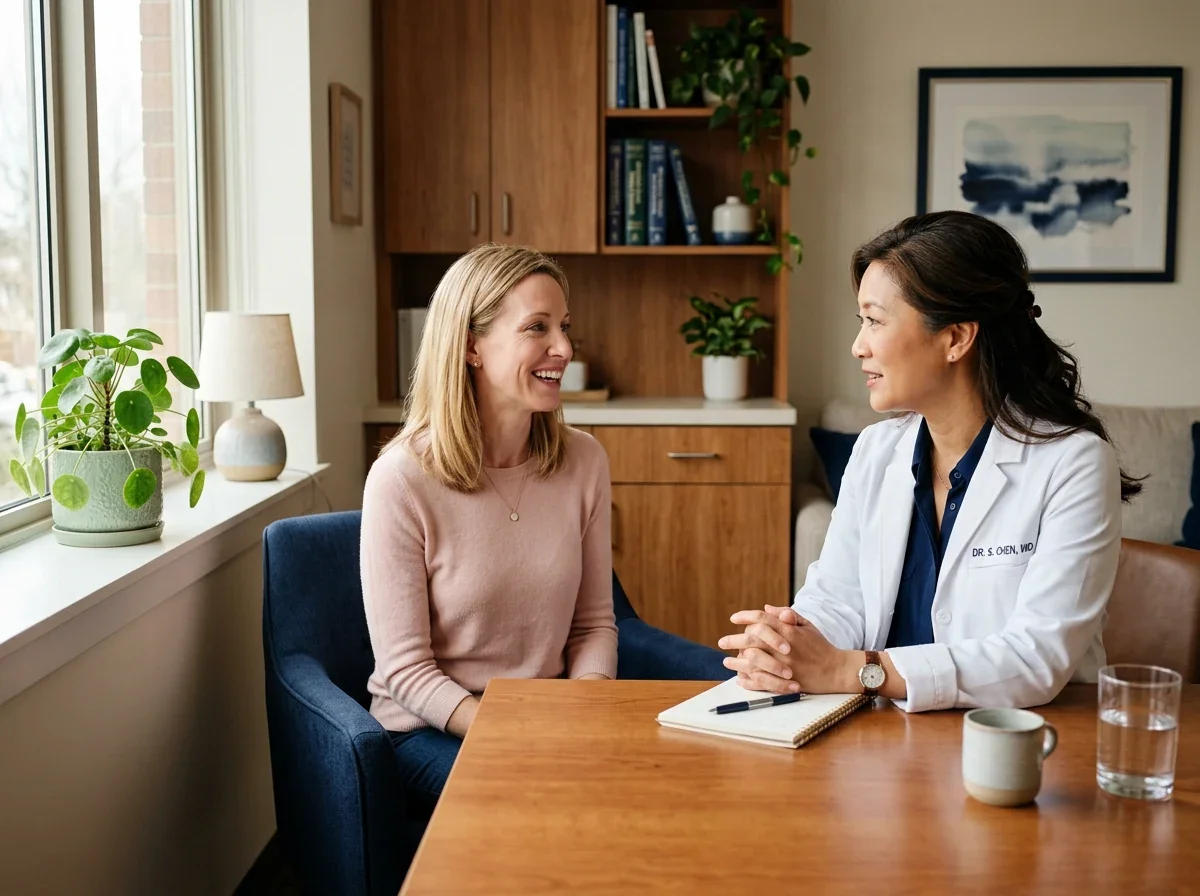
What It Actually Feels Like to Have a Doctor Who Has Time for You
You made the list. You waited. You got fifteen minutes. The thing you most wanted to discuss stayed on the list. For women in midlife, that experience is not a personal failing. It is the predictable output of a system that was not designed for the complexity of their health.
Last updated: May 2026
There is a particular kind of frustration that builds quietly over years of healthcare appointments. You prepare. You make a list of the things you want to cover. You wait. The doctor comes in, moves through the checklist efficiently, and somewhere around the ten-minute mark, you realize the conversation has already turned toward wrapping up. The thing you most wanted to discuss, the fatigue that will not lift, the sleep that has become fractured, the anxiety that arrived without an obvious cause, stayed on your list. You leave with a prescription for something adjacent to the problem, or a referral to another specialist, or a suggestion to take better care of yourself. You drive home wondering whether the symptoms are actually significant or whether you are making too much of them.
For women in midlife, this experience is not a personal failing or a matter of not being assertive enough in the exam room. It is the predictable output of a healthcare system that was not designed with the complexity of women's health in mind, and that gives primary care physicians structurally inadequate time to address it.
The Appointment Problem
Research shows that the average primary care visit in the United States lasts approximately 18 minutes, with a median of 15 minutes. That window of time is expected to cover the reason for the visit, a review of medications, any acute concerns, documentation, and anything else the patient needs. For a woman in her 40s or 50s navigating the hormonal shifts of perimenopause alongside the demands of work, family, and caregiving, 15 to 18 minutes is not a clinical encounter. It is a triage.
This is not a criticism of individual physicians. Most primary care doctors entered medicine because they wanted to practice it thoroughly. The time pressure is structural, built into a reimbursement model that rewards volume and penalizes the kind of longitudinal, relationship-based care that produces better outcomes. The result is that clinically complex patients, and women in perimenopause and menopause are clinically complex patients, consistently receive less than what their health actually requires.

What a Personalized Menopause Evaluation Actually Looks Like
Most women have never had a menopause appointment that felt like enough. At Concierge Medicine of Cincinnati, the evaluation is a dedicated clinical process — not a checkbox at the end of a longer visit. Here is what that looks like in practice.
What Gets Left Behind in a Short Appointment
The menopause transition does not announce itself clearly. It unfolds over years, through a shifting mix of symptoms that can look like depression, thyroid dysfunction, burnout, anxiety, or simply the wear of a busy life. A physician who sees a patient for 15 minutes once a year is not positioned to recognize that pattern. The symptoms get addressed in isolation, if they get addressed at all.
Consider how a single appointment might handle even a partial list of common perimenopause and menopause symptoms:
Sleep disruption that is leaving a patient exhausted but not yet qualifying as clinical insomnia
Mood changes that do not meet the threshold for a depression diagnosis but are significantly affecting the quality of life
Weight gain concentrated around the abdomen that has not responded to diet or exercise changes
Brain fog that a patient struggles to describe because she cannot find the words, which is itself a symptom
Joint pain that has appeared without explanation
Changes in libido that a patient is not sure she is allowed to bring up in a primary care context
Any one of these might consume a 15-minute appointment. Together, they require a different kind of clinical relationship entirely.
Being Dismissed Is Not Rare
The research on how often women feel unheard in medical settings is consistent and troubling. A 2023 survey by Mira found that 65 percent of American women felt their doctor had dismissed, ignored, or minimized the severity of their medical concerns. Among millennial-aged women, that figure rose to 72 percent. A 2024 Kaiser Family Foundation analysis found that nearly half of young women in the United States reported a negative experience with a healthcare provider in the previous two years, including being dismissed or doubted, and that 29 percent of women said their provider had dismissed their concerns, compared with 21 percent of men.
Women in perimenopause and menopause are particularly vulnerable to this dynamic. Their symptoms are real, biologically grounded, and amenable to clinical interventions that can meaningfully address them. But in a short appointment with a provider who may not have received comprehensive training in menopause management, those symptoms can be reframed as expected aging, or stress, or anxiety, and sent out the door without treatment.
The Menopause Society has documented that only 57 percent of physicians are up to date on hormone replacement therapy information, and a 2019 study found that fewer than 7 percent of primary care providers felt adequately prepared to treat menopausal women. Women are not wrong to feel that the system is not meeting them. The data confirms it.
What a Different Model Looks Like
Concierge medicine is built around a different set of premises. A smaller patient panel means that a physician can actually know their patients as individuals, not as a chart that gets pulled up once a year. Appointments are longer by design, not as a luxury but as a clinical requirement for doing the work properly. And the relationship is continuous, meaning that when a patient's symptoms shift or a treatment plan needs adjustment, a physician is available who already has the context.
At Concierge Medicine of Cincinnati, with locations in Mariemont, Kenwood, and Mason, that model is applied directly to the health concerns that matter most to midlife women in the Cincinnati area. The practice is built around the recognition that perimenopause and menopause are not background events in a woman's life. They are a significant health transition with downstream implications for cardiovascular health, bone density, cognitive function, and metabolic health, and they deserve a physician who has the time and the training to address them properly.
In a concierge relationship, an appointment is not a race to the exit. A patient who needs to discuss sleep, hormonal symptoms, mental health changes, and preventive screenings can actually discuss all of those things. The physician has time to ask follow-up questions, review lab results in depth, and develop a care plan that reflects the full picture of a woman's health rather than the most pressing item on a checklist.
What Continuity of Care Actually Produces
One of the most underappreciated advantages of a continuous physician relationship is that it removes the burden of re-explaining from the patient. Women who cycle through urgent care visits, brief annual physicals, and specialty referrals spend enormous amounts of energy bringing each new provider up to speed. They repeat their history, re-describe their symptoms, and often find that the story loses something important in the retelling.
When a physician knows a patient over time, she sees change. She notices that a patient who had been sleeping well reports a shift in sleep. She can connect a new symptom to a medication change from six months prior. She can track the progression of the menopause transition in a way that produces genuinely better clinical decisions, because she has actual longitudinal data on this individual woman rather than a single data point.
That continuity is especially valuable during midlife, when the health landscape is shifting in ways that have long-term consequences. The decisions a woman and her physician make during the perimenopause and menopause window about hormone therapy, bone health screening, cardiovascular risk management, and metabolic monitoring carry forward for decades. Getting that window right matters.
The Care You Have Been Asking For
If you have left a doctor's appointment knowing that the conversation did not go far enough, you are not alone, and you are not wrong. The time pressure that drives that experience is real and a feature of the standard primary care system, not a reflection of your symptoms being minor or your concerns being manageable.
Concierge Medicine of Cincinnati is accepting new patients at all three Cincinnati-area locations. The practice serves women across Mariemont, Kenwood, Mason, and the broader northeast Cincinnati suburbs who are looking for a primary care physician who will actually have time to get to know them.
To learn more or schedule a consultation, visit conciergemedicineofcincinnati.com.